September 14, 2026
Is ERP Dead? No. It Is Changing Shape.
AI, low-code and agents are changing ERP interfaces, development economics and user interaction. They are not removing the need for companies to plan and control their resources.
Author: Fatih Görgülü
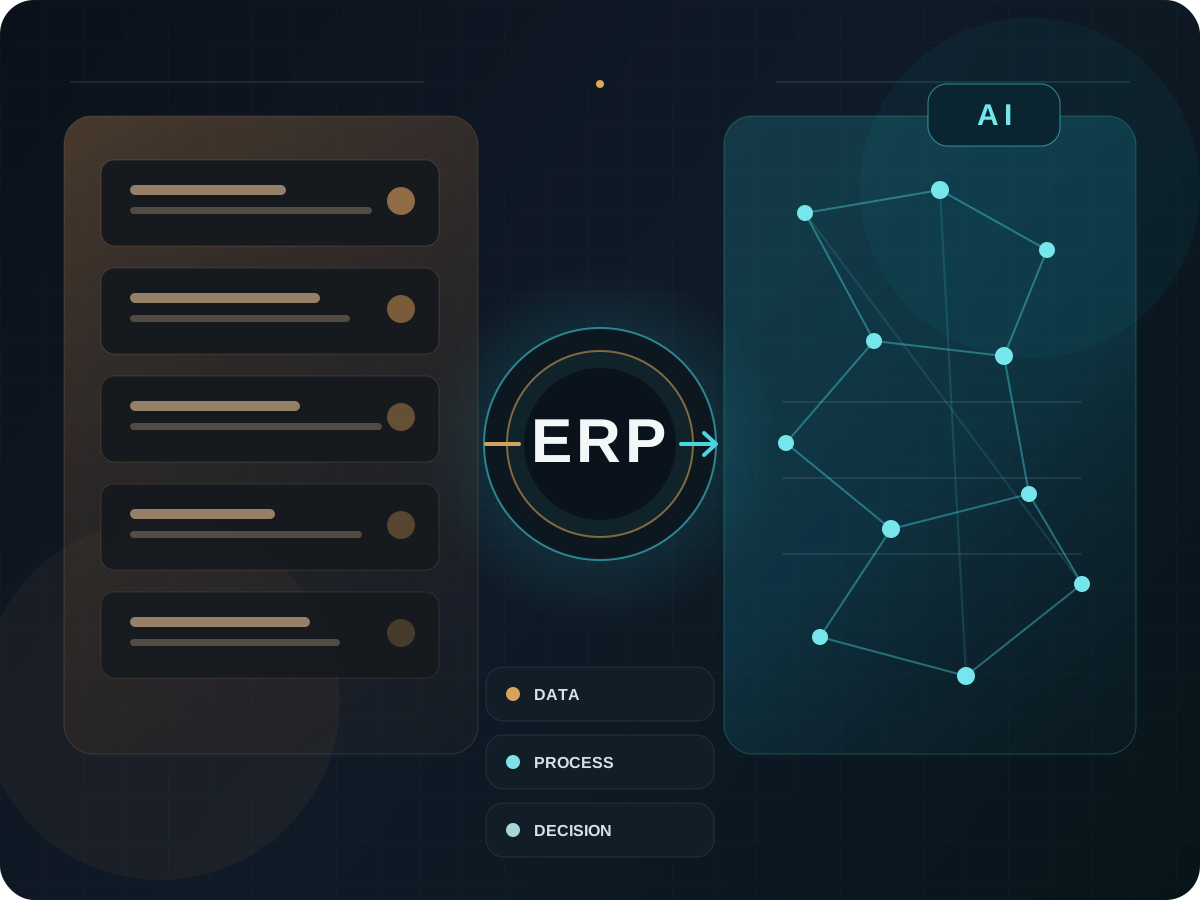
Lately, everyone seems eager to declare something dead: “ERP is dead”, “AI will replace ERP”, “low-code means we no longer need these systems”, “agents will solve everything”.
Start with one distinction: ERP software is one thing. The need for Enterprise Resource Planning is another.
Today’s ERP screens can change. Licensing can change. Monolithic architectures can break into composable services. Users may eventually ask AI agents to perform transactions without opening a traditional ERP screen. All of that is plausible.
But which organization no longer needs to plan inventory, cash, production, procurement, sales, cost and capacity? None.
ERP is changing its shell. The business problem it solves is not disappearing.
ERP is not dying; expectations are rising
Twenty or thirty years ago, putting a stock card into a digital system was transformation. Today we expect the same operating data to help forecast demand, detect anomalies, surface risk, recommend decisions and respond to natural-language questions.
That does not mean resource planning is obsolete. It means the standard for enterprise systems is becoming much higher.
A lot is genuinely changing
Software development costs are falling. Low-code, no-code and vibe coding can compress the time required to produce screens and workflows. AI is becoming useful in analysis, testing, quality control, documentation, decision validation and user support. Work that took weeks may take hours.
That is good progress. But it creates an important distinction: producing a screen faster is not the same as delivering an ERP project.
The ERP bottleneck is often not code
You still have to understand why physical inventory does not match the system, why the bill of materials is not used on the shop floor, why sales promises dates that production capacity cannot support, why cost cannot be explained at month-end, why master data deteriorates and why users resist the new process.
In ERP projects, the constraint is often not code. It is decisions, data, process and people.
AI may make coding ten times faster. It does not automatically make the company ten times faster at decisions, data discipline or process ownership.
Vibe coding can produce an interface in minutes. It does not, by itself, design the right material coding model, costing logic, production planning model or control structure.
Code can become a commodity. Business knowledge does not.
The real threat is not the death of ERP
For many companies, the bigger risk in 2026 is still failing to convert business knowledge, processes and decision mechanisms into reliable digital assets.
AI does not operate on magic. It needs trustworthy data, context, process relationships, authorization and transaction history. A well-implemented ERP remains one of the most important system-of-record layers for operational reality.
As AI becomes more capable, good ERP can become more valuable.
AI does not magically turn bad data into good data or remove weak process discipline. Sometimes it simply produces results from bad data faster.
What might ERP look like next?
We may see fewer ERP screens. Agents may execute more transactions. Natural language may become a primary interface. Licensing, support and implementation models can all change.
Companies will still have to answer the same operational questions: What do we have? What do we need? What should we produce? What should we buy? What does it cost? When can we deliver? How should we use our resources?
That was Enterprise Resource Planning yesterday. It will still be Enterprise Resource Planning tomorrow.
The better question is not “Is ERP dead?” It is “Is ERP ready to become genuinely intelligent?”
Do not confuse changes in technology, pricing, development methods or user interfaces with the underlying business reality. Less “X is dead”. More understanding the field, fixing the data, making the decisions and finishing the project.
Within the ERP cluster
This piece belongs to the ERP and transformation track. It becomes more structured when paired with guides and expertise pages.
A sensible next step after this read
This page may work as an entry or framing layer; the follow-up should be a guide, a resource, or a conversation point.
Relevant guide
Continue inside the guides
If you want a more structured follow-up, the guides hold the checklists, decision frameworks, and implementation discipline.
Continue →Relevant resource
Resources and checklists
Use the resources surface when you want a checklist, decision note, or downloadable asset to make this topic more concrete.
Continue →Conversation
If this is active, let us talk
If this topic matches a live project, sponsor decision, or delivery pressure, you can get in touch directly.
Continue →Related insights
ERP Project Health Check: Is Your Project Really on Track?
An ERP project cannot be considered healthy from its schedule, budget, or completion percentage alone. Decision governance, ownership, scope control, data readiness, user participation, testing discipline, and go-live preparation need to be assessed together.
Read →What are hypercare exit criteria?
Hypercare exit criteria define when the intense post go-live support period can safely move into normal operations. Without them, hypercare either closes too early or turns into an open-ended support phase with unclear scope.
Read →What is Fit-Gap? Managing scope risk in ERP projects
Fit-Gap is not a workshop for collecting every desired change. In an ERP project, it should make the difference between standard use, process decision, configuration, development, phasing, and rejection visible enough for real scope decisions.
Read →